

US Crypto Tax Explained: Cost Basis, Gains & Forms (8949)
Crypto taxes in the US are calculated using the same core idea applied to property: when you dispose of crypto, you calculate a gain or loss. When you receive crypto (like rewards or payment), you may have ordinary income at the time you receive it.
1) The two buckets: capital gains vs ordinary income
A) Capital gains/losses (most common)
If you sell, trade, or spend crypto, the IRS generally treats it like disposing of property—so you calculate capital gain or loss.
B) Ordinary income (when you receive crypto)
If you receive crypto through an airdrop after a hard fork, the IRS generally treats the value you receive as income in the year you receive it.
Similarly, if you receive crypto as payment for goods/services, you generally include its fair market value (USD) as income when received.
2) What counts as a taxable crypto event?
Typical taxable events include:
Selling crypto for USD
Trading crypto for another crypto
Spending crypto (buying goods/services)
Receiving crypto as income (work, rewards, etc.)
Certain airdrops (including hard fork + airdrop when you can control the coins)
Not taxable by itself (usually):
Buying crypto with USD
Holding crypto
Moving crypto between wallets you own (transfers)
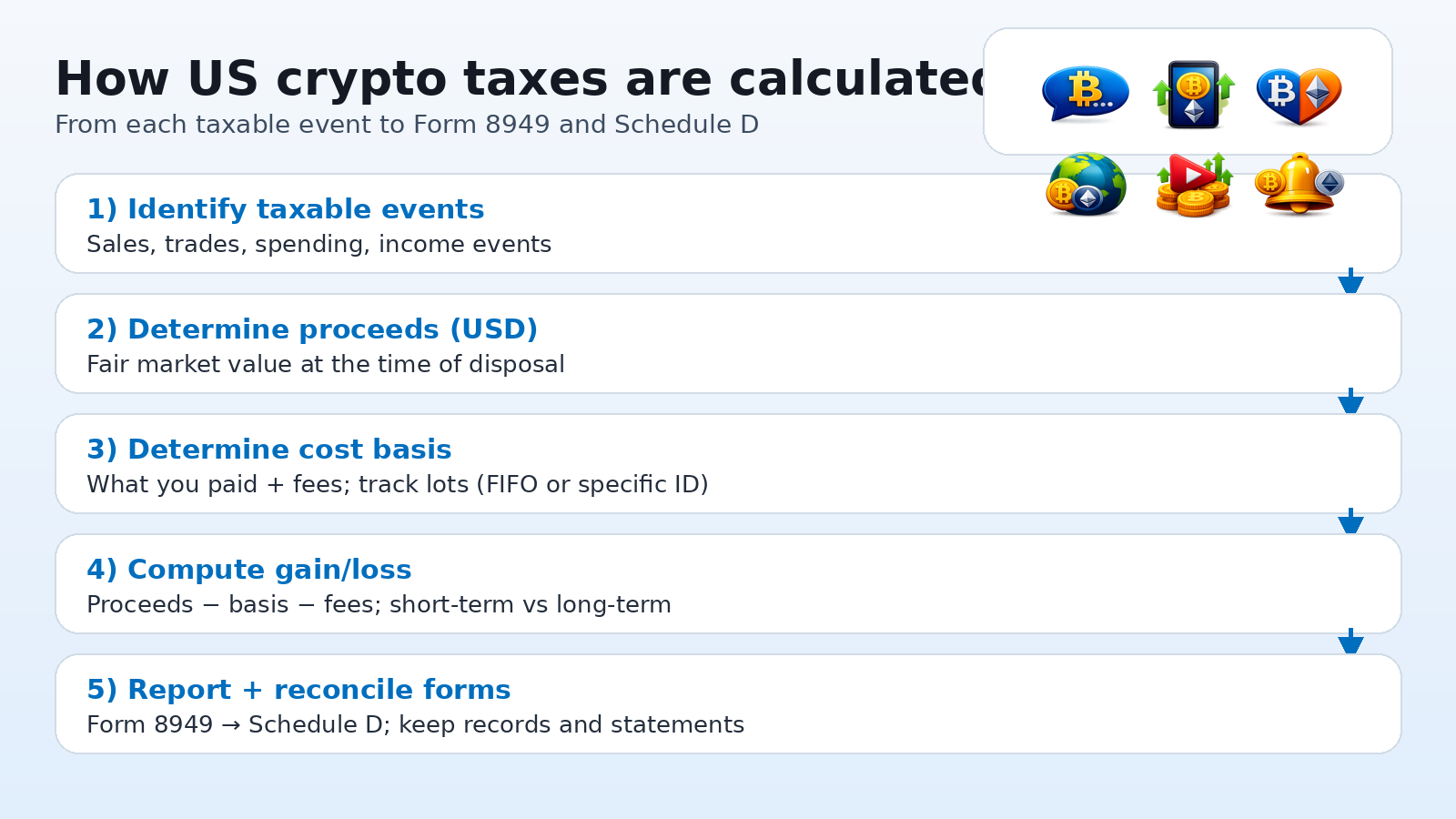
3) The core formula (how the math works)
For every taxable disposal, the basic calculation is:
Capital gain/loss = Proceeds (USD) − Cost basis − Fees
Where:
Proceeds (USD): what you received (or the USD fair market value of what you received) at the time of the disposal
Cost basis: generally what you paid (plus certain fees), measured in USD
Fees: can affect proceeds/basis depending on how the transaction is structured; keep records of them
Example (simple)
You buy 0.01 BTC for $300 (basis = $300).
Later you sell it for $420 (proceeds = $420).
Your gain = $420 − $300 = $120 (fees would adjust this).
4) Short-term vs long-term (holding period)
Holding period changes the tax rate category:
Short-term: held 1 year or less
Long-term: held more than 1 year
Long-term capital gains often have lower rates (commonly 0%/15%/20% depending on income).
5) Cost basis: FIFO vs Specific Identification
If you bought the same coin at different times/prices, you must know which units you sold.
Option A: Specific Identification (allowed if you have records)
You can choose which units were sold if you can specifically identify them and substantiate your basis. The IRS describes acceptable records (timestamps, basis, FMV, etc.).
Option B: FIFO (default if you don’t identify)
If you don’t specifically identify units, the IRS deems you sold the earliest acquired units first (FIFO).
6) How income events are calculated (and why they matter later)
When you receive crypto as income, you generally record:
Ordinary income = FMV in USD on the date received
That FMV becomes your cost basis for those units going forward
So if you later sell those same units, you’ll calculate a capital gain/loss using that basis.
7) How crypto gets reported on US tax forms
Most people report crypto disposals on:
Form 8949 (list each sale/exchange/disposal)
Then totals roll up to Schedule D
The IRS also updated Form 8949 instructions for digital asset transactions, including which boxes to use for short-term vs long-term reporting.
8) 1099-DA and why your numbers still need your own records
The IRS finalized broker reporting rules for digital assets and says reporting will use Form 1099-DA starting with transactions on or after Jan 1, 2025.
For sales effected in 2025, brokers generally report gross proceeds, and basis reporting is phased in later.
Practical takeaway: even if you receive forms, you still need your own complete transaction history to correctly compute basis, holding period, and gains/losses.
9) Recordkeeping checklist (what to save)
The Internal Revenue Service recommends keeping records that document purchases/receipts/sales/exchanges and the USD fair market value for assets received as income.
Keep, at minimum:
Date/time of each transaction
Asset + quantity
USD fair market value at the time
Fees
Wallet/exchange source
Your lot selection method (FIFO or specific ID)
Quick FAQ
Do I pay taxes just for buying crypto?
Usually, no buying with USD is generally not taxable by itself.
Is trading BTC → ETH taxable?
Typically, yes, because it’s treated as exchanging one property for another, triggering gain/loss.
If I move crypto between my own wallets, is it taxable?
Transfers alone are generally not taxable, but you must keep records so you can prove basis and holding period later.
Conclusion:
In the US, crypto taxes are calculated by separating your activity into two main buckets: capital gains/losses when you sell, trade, or spend crypto, and ordinary income when you receive crypto (like rewards, payments, or certain airdrops). The key is tracking cost basis, proceeds (USD value at the time), fees, and holding period (short-term vs long-term) so your totals are accurate when reporting on forms like Form 8949 and Schedule D.
And if you’re publishing crypto tax guides or finance content online, Bulkviews helps you by boosting early visibility and engagement—so your article videos and posts reach more people faster.